
Australia
Payday Super: A Guide for Australian Employers
From 1 July 2026, super is tied to every payday. Learn who is covered, when contributions are due and what payroll and finance teams need to change.
Table of Contents
- Expert Arm
- 26 min read
What is Payday Super?
Payday Super is Australia’s new system for calculating and paying compulsory superannuation guarantee contributions each time an employer pays qualifying earnings. It applies to qualifying earnings paid on or after 1 July 2026 and replaces the former quarterly payment timetable for those payments.
The legal test is more precise than the name suggests. An employer’s super obligation arises on the day qualifying earnings are paid, known as the QE day. The corresponding contribution must generally be received by the employee’s super fund, and be capable of allocation to that employee, no later than the seventh business day after the QE day. Merely scheduling a payment or sending money to a clearing house does not by itself establish that the contribution was received on time.
The operative rules appear in the current Superannuation Guarantee (Administration) Act 1992, particularly the definitions in section 6, the calculation rule in section 17A and the receipt rules in sections 18A to 18D. See printed pages 7–14, 29 and 32–40 of the official PDF.
The commencement and transition are set out in the Treasury Laws Amendment (Payday Superannuation) Act 2025, Schedule 1, item 182, printed pages 67–68.
Executive summary
Payday Super changes the timing, calculation base, reporting and control environment for employer superannuation. The main points are:
- The reform has commenced. It is not a proposal or future measure.
- The statutory rate is 12% of an employee’s qualifying earnings, subject to the annual maximum contributions base and any valid exemption certificate.
- The normal deadline is the seventh business day after the employee is paid qualifying earnings.
- The contribution must reach the relevant fund and be capable of allocation to the employee. An instruction to a bank, payroll platform or clearing house is an earlier step, not the final compliance event.
- Limited extensions apply to the first contribution for a new or recommencing employee, the first contribution to a new fund, specified out-of-cycle payments and exceptional circumstances covered by an ATO determination.
- Employers must report both year-to-date qualifying earnings and super liability through Single Touch Payroll.
- A late or insufficient contribution can create a superannuation guarantee charge for the individual QE day, together with notional earnings, an administrative uplift and, where relevant, a choice loading.
- The ATO’s first-year compliance approach affects how it prioritises reviews. It does not postpone the legal deadline or create a grace period.
- Payroll outsourcing can support calculation, processing, reconciliation and exception reporting, but the employing entity remains responsible for approving, funding and meeting its legal obligations.
The practical conclusion is straightforward: super can no longer sit as a routine quarter-end task. It must form part of every pay run, with enough time left to detect and correct rejected or unallocated contributions before the statutory window closes.
What changed on 1 July 2026?
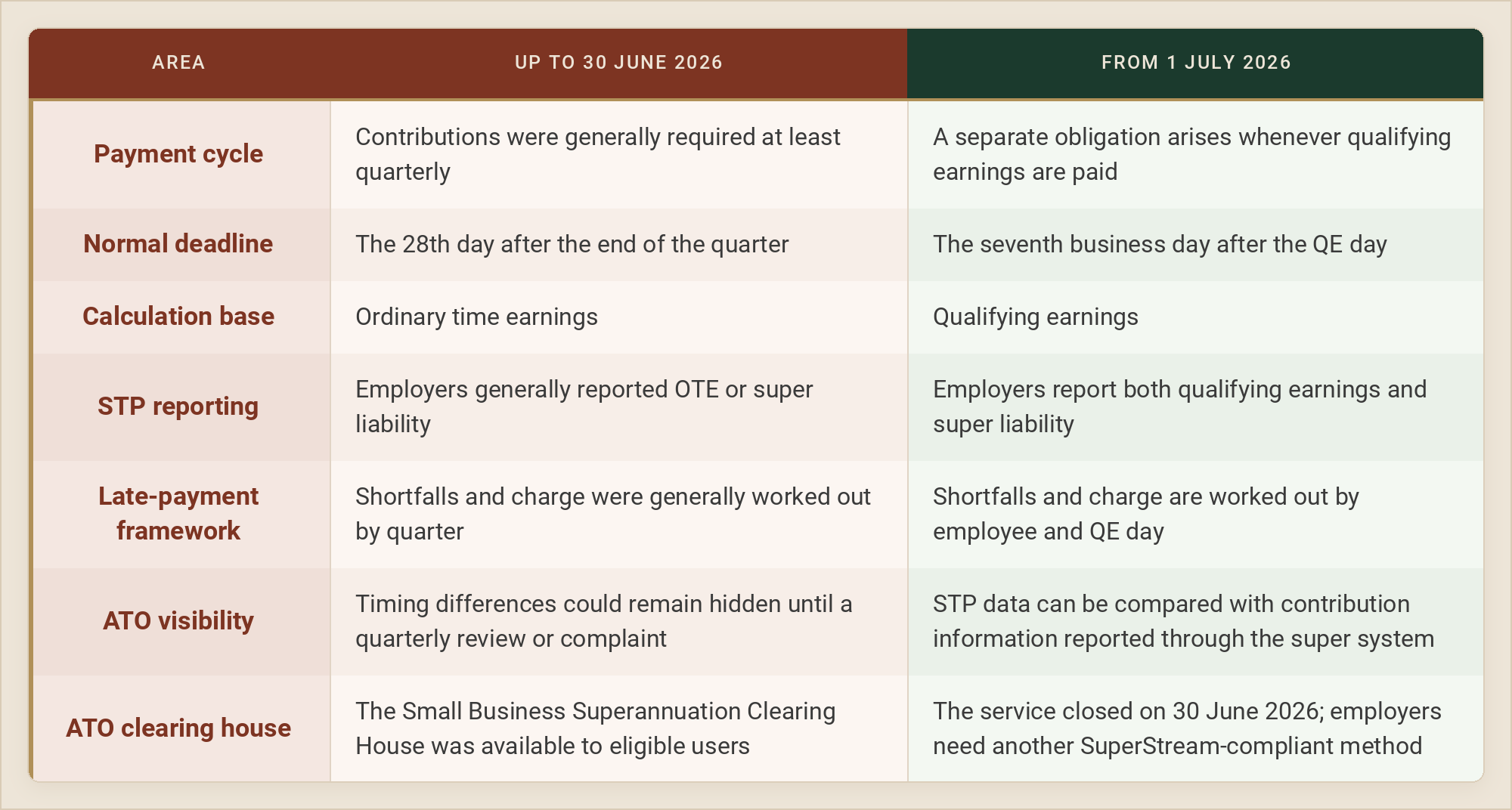
The Superannuation Guarantee Charge Amendment Act 2025 changed the imposition of the charge from a quarter to a QE day and commenced on 1 July 2026.
See sections 2–3 and Schedule 1, printed pages 2–3. The ATO’s Payday Super overview sets out the corresponding operational changes.
Who must comply?
Which employers are covered?
There is no general small-business exemption from the Payday Super timetable. If an entity has a superannuation guarantee obligation for a worker, the new timing rules apply to qualifying earnings paid on or after 1 July 2026. The legal form, industry and number of employees do not remove that obligation.
The first step is therefore not to look at the payroll frequency. It is to identify every person who is an employee for superannuation guarantee purposes. The statutory meaning is wider than the label used in an employment contract or accounting system.
Which workers are covered?
The rules generally cover:
- employees aged 18 or over;
- employees under 18 who work more than 30 hours in a week;
- full-time, part-time and casual employees;
- company directors who are paid for performing their duties;
- certain contractors where the contract is wholly or principally for that individual’s labour;
- certain performers, presenters, musicians, athletes and people providing related services;
- temporary residents, subject to specific statutory and international-agreement exclusions; and
- former employees when a later payment of qualifying earnings is made to or for them.
The extended employee rules for directors, labour-based contractors and specified performers are in section 12 of the Superannuation Guarantee (Administration) Act 1992, printed pages 21–23. The application to former employees appears in section 15B, printed page 25. The Fair Work Ombudsman’s tax and superannuation guidance also confirms the general age, hours and worker-coverage rules.
A worker described as a contractor is not automatically outside the super system. If the engagement is principally for that person’s labour, the payer may still be treated as the employer for super purposes. The written label, use of an ABN or issue of an invoice is not decisive on its own.
What are qualifying earnings?
Qualifying earnings, commonly shortened to QE, are the amounts used to calculate the super guarantee under Payday Super. They include:
- ordinary time earnings;
- all commissions;
- payments for duties as a member of a company’s executive body, including a board of directors;
- labour payments under contracts that fall within the extended employee rule;
- specified payments to performers, presenters, athletes and related workers;
- certain government and parliamentary remuneration; and
- amounts an employee gives up under a salary sacrifice arrangement in exchange for an employer super contribution.
An amount covered by more than one category is counted once, not twice.
The complete statutory definition is in section 10A of the Superannuation Guarantee (Administration) Act 1992, printed pages 19–21.
Salary sacrifice does not reduce the employer’s compulsory SG amount. The sacrificed amount remains within qualifying earnings, while section 18A excludes a sacrificed contribution from the eligible employer contributions used to reduce the SG shortfall.
If an employee has $4,000 of qualifying earnings before sacrificing $400, the statutory SG calculation remains:
$4,000 × 12% = $480
Subject to the arrangement and contribution caps, the employer would ordinarily send the $400 sacrificed contribution as well as the $480 compulsory contribution.
Qualifying earnings are not always the same as gross pay. A payroll team must determine the nature of each pay item rather than applying 12% to the net payment or every amount appearing on a payslip.
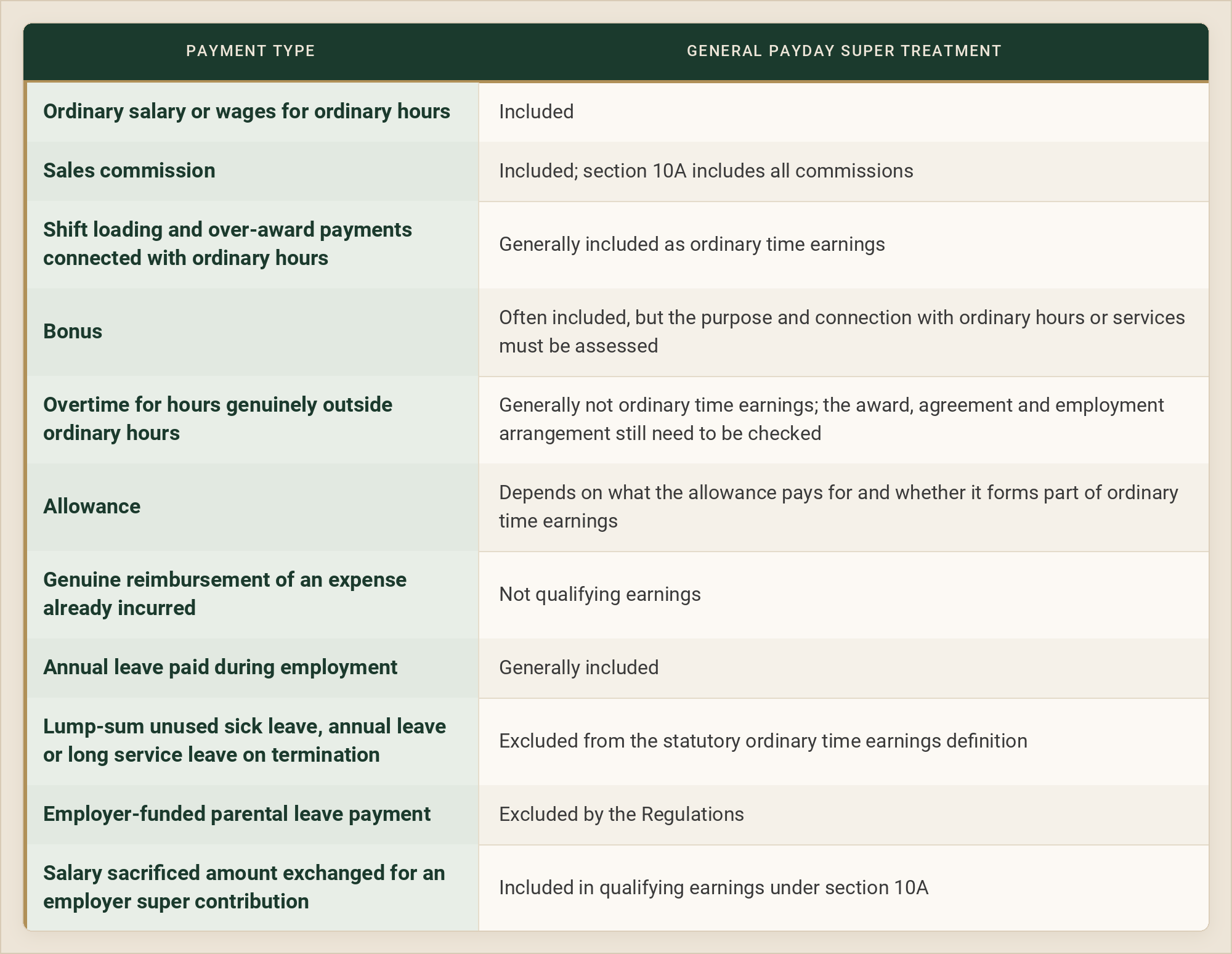
The exclusions prescribed by law include a part-time employee under 18, specified parental-leave payments, fringe benefits, certain foreign-work payments and limited domestic or private work. See sections 11–12 of the current Superannuation Guarantee (Administration) Regulations 2018, printed pages 10–12. The ATO’s qualifying earnings guidance should be used when mapping payroll categories.
Example 1: gross pay is not always qualifying earnings
Mia receives the following amounts on a payday:
- ordinary salary: $3,000;
- sales commission: $500; and
- reimbursement for a documented business expense: $120.
Mia’s cash payment before deductions is $3,620, but her qualifying earnings are $3,500. The reimbursement is repayment of an expense rather than earnings. The employer’s statutory super amount is:
$3,500 × 12% = $420
If the $120 had instead been a taxable allowance forming part of Mia’s ordinary time earnings, the result could be different. Pay-code descriptions should therefore record the underlying purpose of the payment.
Is there an earnings limit?
Yes. The Act contains an annual maximum contributions base derived from the basic concessional contributions cap and the 12% charge percentage. For 2026–27, the ATO confirms that the maximum contributions base is $270,830.
Once an employee’s qualifying earnings from the same employer reach $270,830 for 2026–27, later payments by that employer are treated as nil for the statutory SG calculation. At 12%, the maximum calculation is $32,499.60 because the base is rounded down to the nearest $10.
The formula and employer-by-employer application appear in section 10A(5)–(6) of the Superannuation Guarantee (Administration) Act 1992, printed pages 20–21.
This statutory ceiling does not override a more generous obligation in an award, enterprise agreement, employment contract or fund arrangement. It also changes when the concessional contributions cap changes, so payroll settings should be reviewed at the start of every financial year.
Payment rules
What is the payday or QE day?
The QE day is the day the employer pays qualifying earnings to or for an employee. If several qualifying-earnings payments are made to the same employee on the same day, they are combined for that day’s statutory calculation. If a payment is made after employment ends, it can still create a QE day where the amount is qualifying earnings.
The obligation is calculated as:
Qualifying earnings paid on the QE day × 12%
The formula is in section 17A of the Superannuation Guarantee (Administration) Act 1992, printed page 29. The reform did not increase the SG rate on 1 July 2026; the rate had already reached 12% from 1 July 2025.
When must the contribution arrive?
The normal period starts on the QE day and ends on the seventh business day after it. A business day excludes Saturdays, Sundays and a public holiday observed throughout a State, the Australian Capital Territory or the Northern Territory. See the definitions of “business day” and “usual period” in section 6 of the Superannuation Guarantee (Administration) Act 1992, printed pages 7 and 14.
The safest operational approach is to initiate super with, or immediately after, the wage payment. Seven business days is the deadline for fund receipt, not a recommended waiting period. Banking cut-offs, clearing-house processing, incorrect member information and fund rejection all consume part of that window.
Example 2: a normal fortnightly payroll
An employee is paid $4,000 of qualifying earnings on a Tuesday. The employer’s contribution is:
$4,000 × 12% = $480
Assuming there is no whole-of-jurisdiction public holiday during the period, the seventh business day after Tuesday is Thursday of the following week. The $480 must be received by the fund and capable of allocation to the employee by that Thursday.
If the employer sends the batch to a clearing house on Thursday but the fund receives it on Friday, the contribution is late.
The ATO’s payment-deadline guidance should be used to confirm dates affected by public holidays or special circumstances.
What does “received and allocable” mean?
For an ordinary accumulation fund contribution, the money must be received by a complying fund or retirement savings account and the fund must have enough information to allocate it to the employee. Incorrect fund identifiers, member numbers, names or dates of birth can prevent allocation even when money has left the employer’s bank account.
Sections 18A and 18C of the Superannuation Guarantee (Administration) Act 1992, printed pages 32–38, make receipt and eligibility central to whether a contribution reduces the employer’s shortfall.
This is why a payment confirmation from a payroll platform should not be the final control. The business should also monitor acceptance, rejection and return messages.
When can a different timing rule apply?
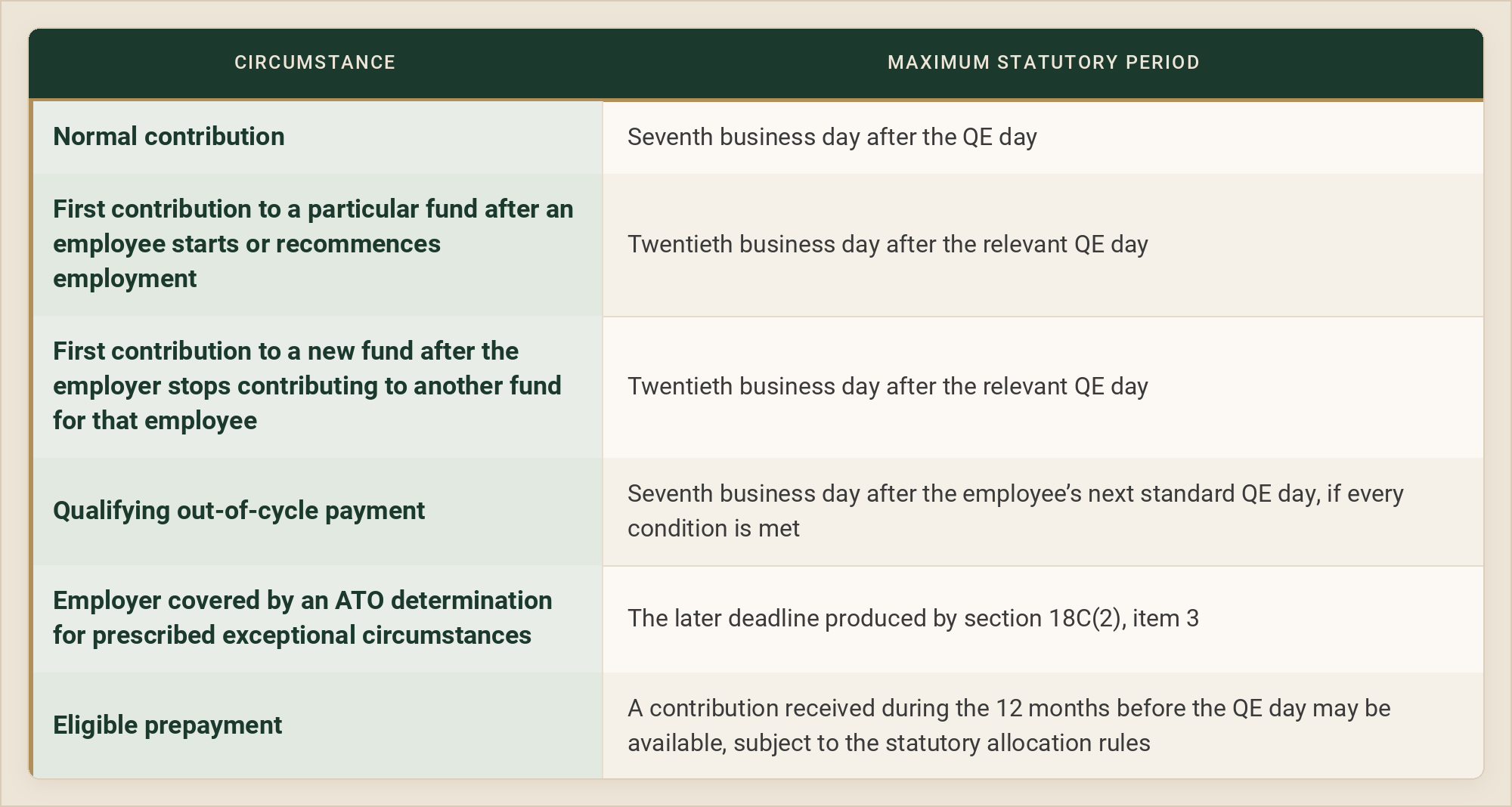
These rules are contained in section 18C(1)–(4) of the Superannuation Guarantee (Administration) Act 1992, printed pages 36–38. The ATO’s guidance for a new employee or fund explains the 20-business-day rule.
The 20-business-day period is not a general onboarding holiday. It applies to the first eligible contribution to the relevant fund in the circumstances specified by the Act. Employers should obtain valid fund details early and avoid relying on the full extension as their routine process.
How do out-of-cycle payments work?
The ATO’s legislative determination identifies six kinds of payment that may qualify:
- allowances;
- bonuses;
- commissions;
- loadings;
- payments in advance; and
- back payments.
The category alone is not enough. All of the following must also occur:
- The employer has an established timing, pattern or schedule for paying qualifying earnings to that employee.
- The payment is made outside that established schedule.
- The employer later makes a payment that is not out of cycle on the next scheduled pay date for that employee.
See section 5 of the Superannuation Guarantee (Administration) (Out-of-Cycle Qualifying Earnings) Determination 2026, printed pages 1–2.
Example 3: an allowance paid between regular paydays
Sam is paid ordinary wages every second Thursday. He receives an allowance on Tuesday 7 July 2026, outside the regular cycle, and then receives his next ordinary pay on Thursday 16 July 2026.
If the allowance is qualifying earnings and all conditions are satisfied, its super may be received by the seventh business day after the 16 July standard QE day, which is 27 July 2026.
This example follows the official Explanatory Statement to the Out-of-Cycle Qualifying Earnings Determination 2026, PDF page 5.
If the same bonus or allowance is paid on the employee’s normal payday, it is not out of cycle and the ordinary seven-business-day deadline applies.
If a final payment is made after termination and no later standard QE day will occur for that employee, the out-of-cycle extension is also unavailable.
What counts as exceptional circumstances?
The current Regulations prescribe natural disasters and widespread outages of technology services or platforms used to make contributions. An employer cannot simply decide that an internal delay was exceptional. The employer and relevant QE day must be covered by a determination made by the Commissioner.
See section 13 of the Superannuation Guarantee (Administration) Regulations 2018, printed page 13, and section 18C(4) of the Act, printed pages 38–39.
How did the transition operate?
The new law applies according to the payment date, even where the work was performed earlier. For example, qualifying earnings for work performed in June 2026 but paid on 2 July 2026 fall under Payday Super.
This rule appears in the Treasury Laws Amendment (Payday Superannuation) Act 2025, Schedule 1, item 182(1)–(2), printed page 67.
The quarter ending 30 June 2026 remained subject to the former quarterly rules and its ordinary contribution deadline remained 28 July 2026.
Where an employer had a shortfall for that quarter, eligible contributions made from 1 July to 28 July 2026 were first applied under the old law to that June-quarter obligation. Only the remainder could be applied to QE days on or after 1 July.
See Schedule 1, item 186, printed pages 69–70, and the ATO’s changeover guidance.
That transition is especially important when reviewing July 2026 records. A single contribution batch should not be assumed to have satisfied both the final quarterly amount and the first Payday Super liabilities.
Who administers and monitors the rules?
The bodies have different responsibilities:
- Australian Taxation Office: The Commissioner has general administration of the Superannuation Guarantee (Administration) Act. The ATO receives employer reporting, can compare STP data with super contribution information, accepts voluntary disclosures, makes SGC assessments and undertakes recovery and enforcement. The statutory administration power is in section 43, printed page 76.
- Fair Work Ombudsman: The FWO explains workplace super entitlements under the National Employment Standards, awards and enterprise agreements. The ATO remains the primary enforcement agency for compulsory SG, but a late payment may also breach the Fair Work Act, an award or an enterprise agreement. See the FWO’s Payday Super guidance.
- Superannuation funds and SuperStream providers: Funds receive and allocate contributions and provide transaction information through the superannuation reporting system. A clearing house or payroll platform transmits the payment and data, but does not assume the employer’s legal obligation.
- APRA and ASIC: APRA prudentially supervises regulated superannuation entities, while ASIC regulates conduct and disclosure. They are not the bodies that calculate an employer’s Payday Super shortfall; that function sits principally with the ATO.
Late payments
What happens when super is late or insufficient?
A shortfall can arise for each employee and each QE day. Paying the missing contribution later is still important because a late eligible contribution received before assessment can reduce the final shortfall.
It does not change the fact that the contribution missed its original deadline, and it may not remove the notional earnings or every other charge component.
The superannuation guarantee charge can contain: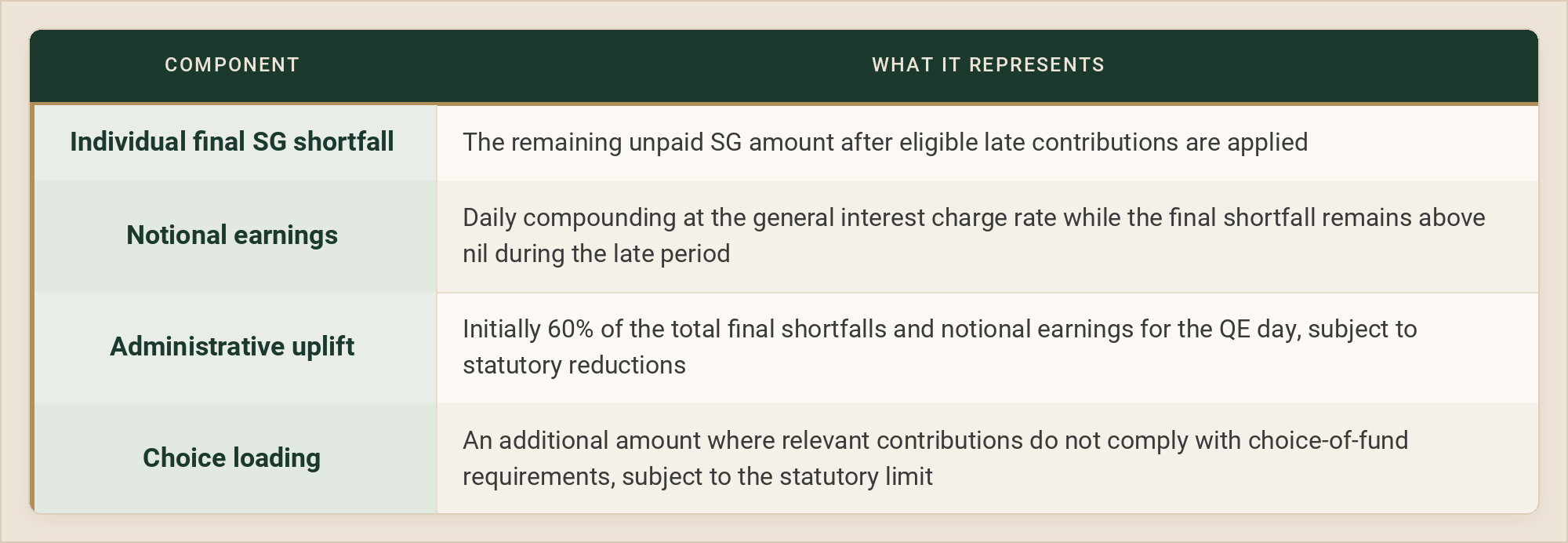
The four components are listed in section 16B of the Superannuation Guarantee (Administration) Act 1992, printed page 28. Late contributions and notional earnings are addressed in sections 18D and 19A, printed pages 39–41.
The 60% starting uplift is in section 19B, printed page 41, and choice loading is addressed in section 20A, printed pages 42–43.
How can the administrative uplift be reduced?
The current Regulations provide two forms of reduction:
- A 20-percentage-point reduction may apply where there has been no relevant Commissioner-initiated assessment or estimate during the applicable 24-month lookback period. For QE days from 1 July 2026 to 30 June 2028, that lookback is treated as starting on 1 July 2026.
- A further reduction may apply where the employer lodges a valid voluntary disclosure statement in the approved form before the ATO makes an assessment for that QE day.
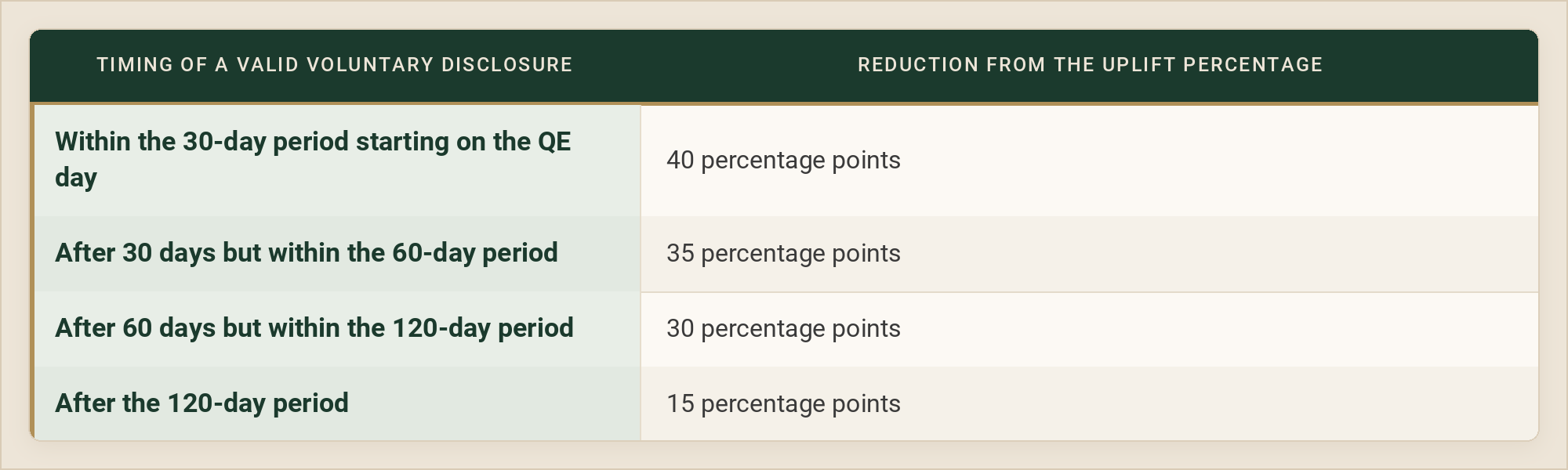
For an employer eligible for the 20-point compliance-history reduction, a valid disclosure within the first 30-day period can reduce the administrative uplift percentage from 60% to nil. It does not make the contribution on time or automatically remove the shortfall and notional earnings.
The legal rules appear in sections 13A–13D of the Superannuation Guarantee (Administration) Regulations 2018, printed pages 14–16. Section 33 of the Act, printed page 71, requires the disclosure to be lodged before assessment and in the approved form.
Employers should use the ATO’s voluntary-disclosure guidance and obtain advice from a registered tax professional where necessary.
What is the ATO’s first-year compliance approach?
The ATO’s Practical Compliance Guideline PCG 2026/1 applies from 1 July 2026 to 30 June 2027. It describes how the ATO will prioritise compliance work during the first year:
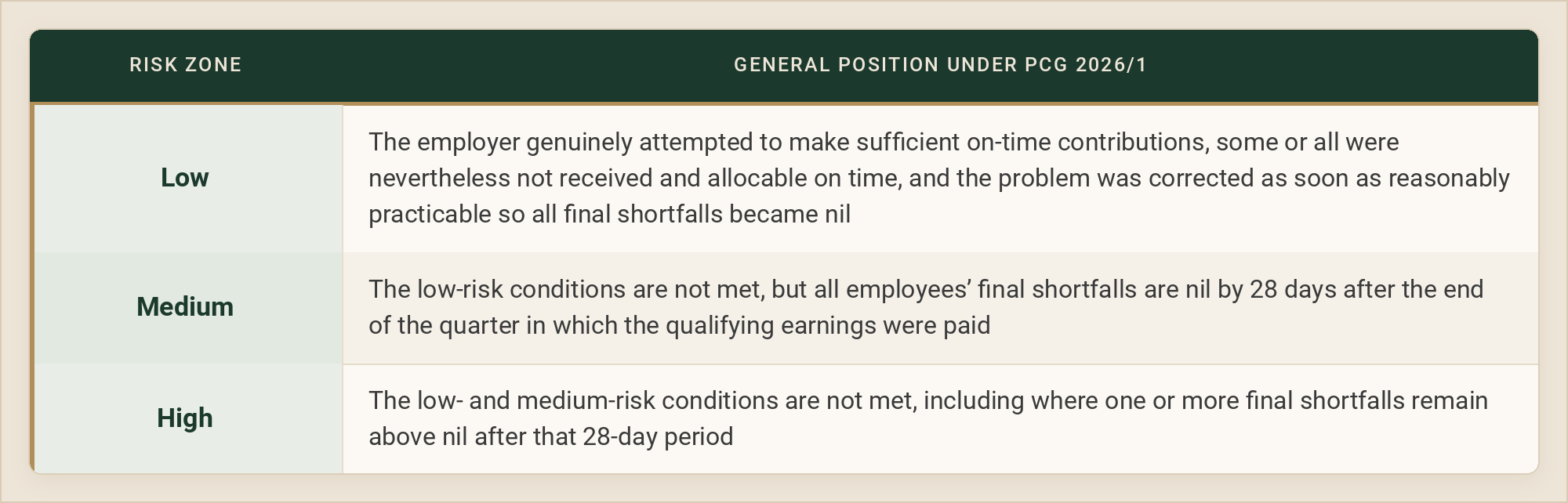
The ATO’s first-year compliance guidance and PCG 2026/1 should be read together.
The risk zones are an administrative prioritisation framework. They do not alter the seven-business-day rule, extinguish SGC or turn 28 days after quarter-end into an alternative payment deadline.
Continuing to pay quarterly may place an employer in the medium-risk zone if all shortfalls are eventually cleared, but those contributions remain late under the Act.
Example 4: a contribution is rejected
An employer calculates $480 correctly and submits the payment early, but the employee’s member number is wrong. The fund rejects the contribution and the money is returned after the seven-business-day period.
The employer should correct the member information and resubmit the contribution immediately. Prompt correction can reduce the final shortfall and may support low-risk treatment under PCG 2026/1 where the employer made a genuine on-time attempt.
It does not retrospectively make the original contribution eligible, because the money was not received and allocable by the deadline.
What if an assessed charge is not paid?
General interest charge accrues on unpaid SGC after it becomes due. If SGC remains unpaid 28 days after it became payable, the Commissioner must issue a notice in the circumstances set out in section 59A.
Failure to pay the notice amount during the further notice period can produce a penalty equal to 25% of the unpaid amount, increasing to 50% where a relevant earlier penalty arose during the preceding 24 months. A nil percentage applies where the statutory exceptional-circumstances condition is met.
See sections 49 and 59A–59D of the Superannuation Guarantee (Administration) Act 1992, printed pages 77 and 80–83. The ATO’s guidance on unpaid SGC explains the recovery sequence.
For QE days from 1 July 2026, the SGC itself is tax deductible. General interest charge arising after assessment and the late-payment penalty are not deductible.
This differs from the former quarterly framework and should be reflected correctly in tax workpapers.
See items 79–80 of Schedule 1 to the Treasury Laws Amendment (Payday Superannuation) Act 2025, printed page 49, and the ATO’s SGC guidance.
Payroll actions
What should employers and accountants do now?
The following sequence turns the legislation into a workable pay-cycle process.
- Confirm the worker population. Review employees, directors, casuals, temporary residents and individual contractors. Escalate uncertain contractor classifications before the next payment, not after a shortfall appears.
- Map every pay code to qualifying earnings. Document whether salary, commission, bonus, allowance, leave, overtime, termination and reimbursement codes are included or excluded, together with the reason. Do not rely on an old OTE setting without review.
- Validate the 12% calculation and annual cap. Test ordinary pay, mixed earnings, salary sacrifice, negative adjustments, back pay and high-income employees. Confirm that the 2026–27 maximum contributions base is applied by employer and employee.
- Confirm fund and employee details before payroll. Obtain a valid choice, check the fund identifier and member information, and complete any required stapled-fund process. The first-contribution extension should be a safeguard, not the standard onboarding timetable.
- Use a current SuperStream-compliant payment method. The ATO’s Small Business Superannuation Clearing House closed on 30 June 2026. Confirm the replacement service’s submission cut-offs, expected settlement times, error messages and correction process.
- Set the payment date well before the legal deadline. The internal due date should allow time for a rejection and resubmission. A business that waits until the seventh business day has no recovery margin.
- Align approval authorities with every pay cycle. Establish primary and backup approvers, payment limits and leave coverage. Weekly payroll should not depend on one person being available every week.
- Report the correct STP amounts. Report year-to-date qualifying earnings and year-to-date super liability for each employee. Reconcile the STP output to the final payroll register before submission. The ATO’s changeover guidance explains the reporting transition.
- Reconcile beyond the bank debit. Match the payroll calculation to STP, the payment instruction, bank settlement, clearing-house status and fund acceptance. The control is complete only when exceptions and returns have been investigated.
- Operate a rejection and shortfall register. Record the employee, QE day, original deadline, amount, reason, correction date, receipt evidence, owner and whether specialist advice or a voluntary disclosure is required.
- Forecast cash by payday. Super is no longer a quarterly amount available for short-term working capital. Include the super cash requirement in each payroll funding approval.
- Retain evidence for at least five years. The Act requires records that explain relevant transactions and allow the liability to be readily ascertained. Section 79 of the Superannuation Guarantee (Administration) Act 1992, printed pages 97–98, contains the record-keeping and retention rules.
How does Payday Super change accounting and reporting?
The annual employment cost may not change solely because payment is more frequent, but the ledger and close process do.
- Super payable turns over faster. The liability created by each pay run should normally clear within days rather than accumulate to quarter-end.
- An aged balance is a compliance signal. A super payable amount that remains outstanding beyond its fund-receipt deadline may represent more than a timing difference. It should be investigated by employee and QE day.
- Month-end cut-off needs supporting detail. A balance at reporting date may still be within its seven-business-day period. The reconciliation should identify the QE day, statutory deadline and actual status instead of treating the whole control account as one amount.
- Cash forecasting moves to payroll frequency. Weekly, fortnightly and monthly payrolls require matching super funding at the same rhythm.
- STP becomes part of the reconciliation evidence. The year-to-date qualifying earnings and super liability reported to the ATO should agree to payroll records and explain later adjustments.
- Clearing-house suspense requires active review. Amounts debited but rejected, returned or unallocated should not be treated as completed contributions.
- Late-payment costs need separate coding. The underlying contribution, notional earnings, administrative uplift, post-assessment interest and penalties may have different accounting and tax treatments. Clear general-ledger codes make review and tax preparation more reliable.
Example 5: the cash-flow timing changes, not the 12% rate
A business has 20 employees, each with $2,000 of qualifying earnings per fortnight.
The super requirement for each pay run is:
20 × $2,000 × 12% = $4,800
Across 26 fortnights, the annual amount is $124,800 before adjustments. Under the old timetable, roughly $31,200 could build up over an average quarter.
Under Payday Super, the business needs approximately $4,800 funded and processed with each fortnightly payroll. The annual cost is the same in this simplified example, but the business can no longer use the accumulating quarterly liability as working capital.
Who should own each control?
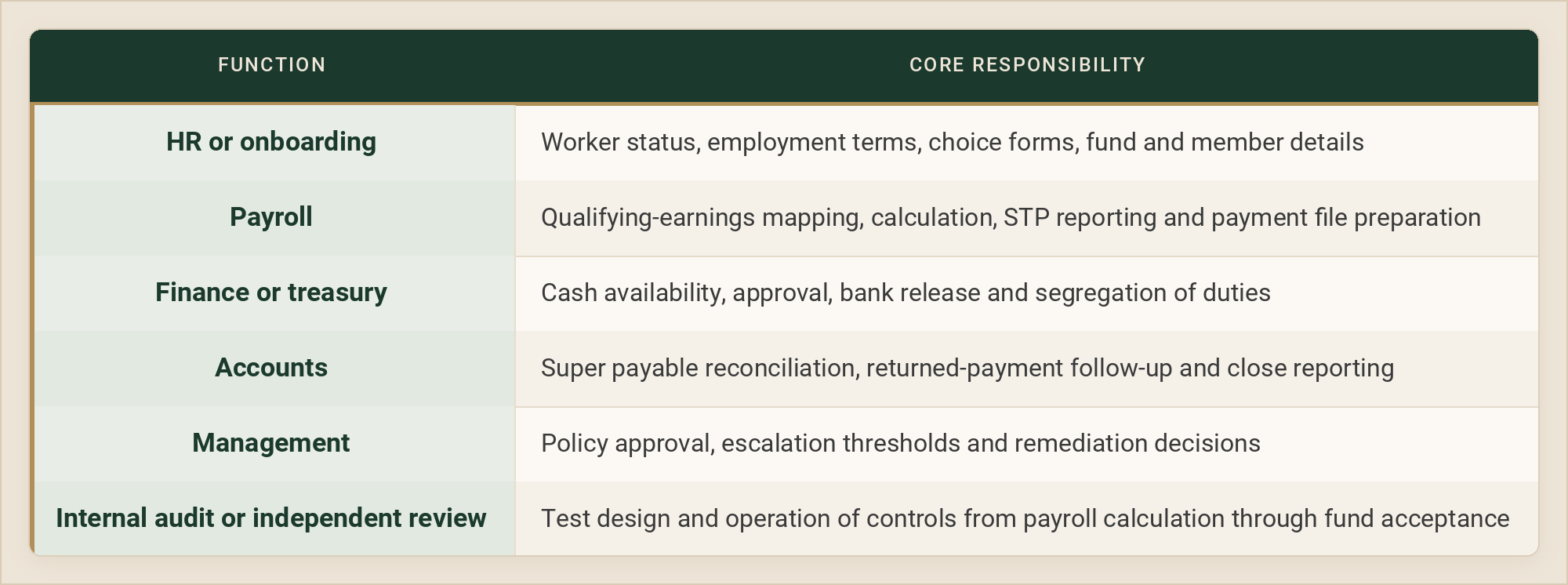
The hand-off between these functions is where failures often occur. A payroll report may be correct while the payment remains unapproved; the bank may release the money while the fund rejects the employee data; or the contribution may be corrected while the exception is omitted from the accounting and tax workpapers.
The control should cover the complete chain.
FAQs
Can an employer continue paying super quarterly?
No. For qualifying earnings paid from 1 July 2026, the ordinary legal deadline is seven business days after each QE day. A quarterly catch-up may clear a final shortfall for the ATO’s first-year risk framework, but the earlier contributions were still late.
Does the money have to reach the fund on the same day as wages?
Not under the ordinary statutory receipt rule. The liability arises on payday, and the fund normally has to receive an allocable contribution by the seventh business day after that date.
Initiating the contribution with payroll is the safer operating practice because it preserves time to correct errors.
Does payment to a clearing house count as payment to the employee’s fund?
Not by itself. The relevant legal question is whether an eligible contribution was received by the fund or other relevant recipient and could be allocated to the employee within the applicable period.
What happens if the fund rejects the contribution?
Correct the data and resubmit the contribution immediately. If it was not received and allocable by the deadline, a base shortfall can arise even if the employer tried to pay on time.
Keep the rejection message, correction evidence and final receipt information.
What is the deadline for a new employee?
The first eligible contribution to a particular fund after the employee starts or recommences can be received within 20 business days after the relevant QE day.
The same extension applies to the first contribution to a new fund after the employer stops contributing to another fund for that employee.
Does every bonus receive the out-of-cycle extension?
No. The bonus must be qualifying earnings, paid outside an established schedule, and followed by the employee’s next standard qualifying-earnings payment on the expected scheduled date.
A bonus paid on the normal payday follows the normal seven-business-day deadline.
Are contractors covered?
Some are. A person working under a contract wholly or principally for their labour can be treated as an employee for SG even if the arrangement calls them a contractor. The full facts of the engagement must be reviewed.
Is super payable for an employee under 18?
Yes, if the employee works more than 30 hours in a week. A part-time employee under 18 is excluded under the current Regulations.
What if June work was paid in July 2026?
The payment date controls the new regime. Qualifying earnings paid on or after 1 July 2026 fall under Payday Super even if the work was performed before that date.
Does PCG 2026/1 give employers a first-year grace period?
No. It explains where the ATO is more or less likely to apply compliance resources during 2026–27. It does not amend the deadline or remove SGC imposed by the legislation.
Is the new superannuation guarantee charge deductible?
The SGC relating to QE days from 1 July 2026 is tax deductible. Post-assessment general interest charge and the late-payment penalty are not.
The old quarterly treatment should not be carried forward without checking which regime applies.
How long should payroll and payment records be retained?
The SG Act generally requires relevant records to be retained for five years after they were prepared or obtained, or five years after completion of the related transaction or act, whichever is later.
Does outsourcing payroll transfer the employer’s legal responsibility?
No. A payroll provider can calculate, prepare, report, reconcile and monitor within its agreed scope, but the employing entity remains responsible for accurate information, adequate funds, timely approvals and satisfaction of its statutory obligations.
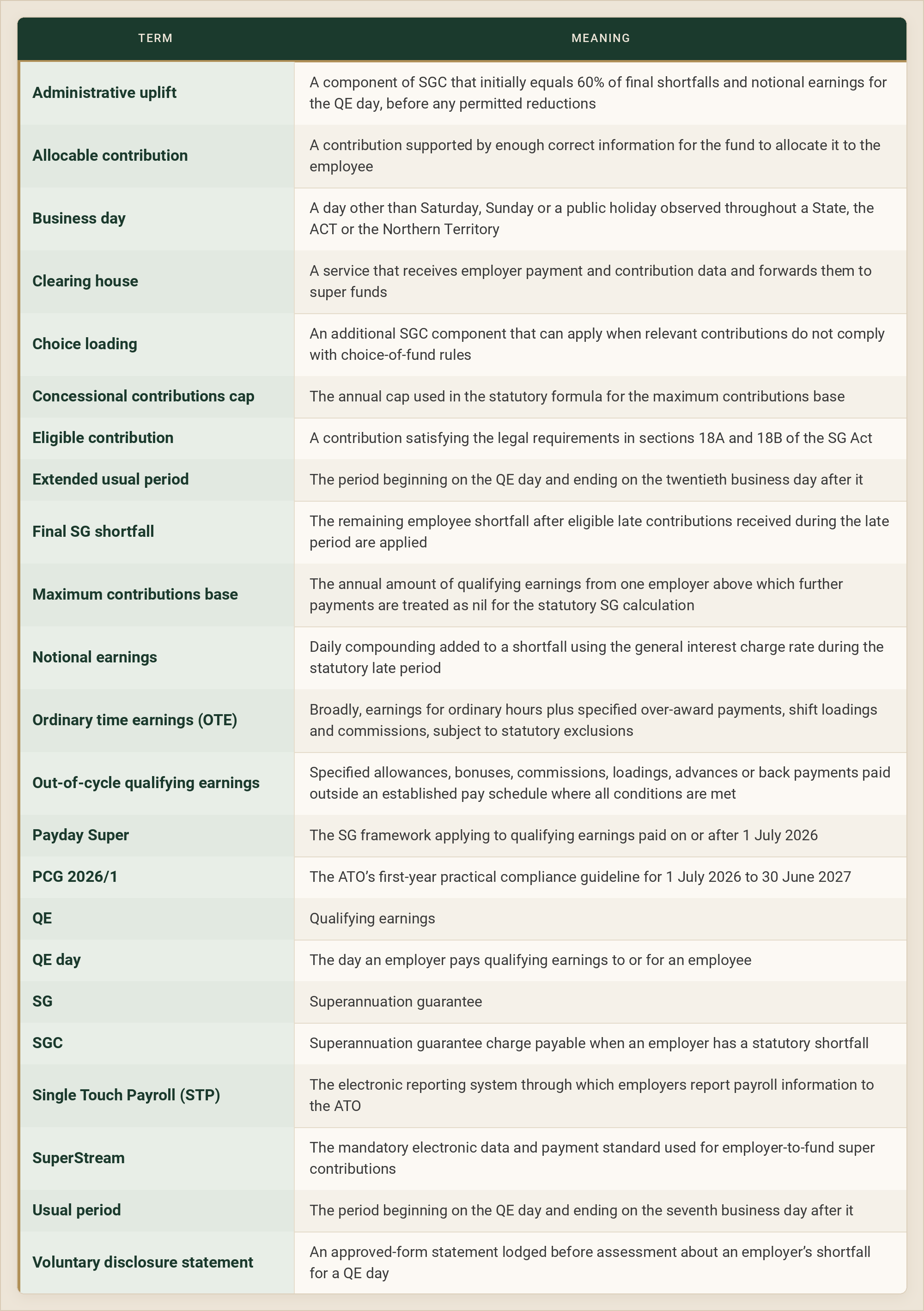
Glossary
Conclusion
Payday Super moves compulsory superannuation from a quarterly compliance exercise into the normal payroll cycle. Every payment of qualifying earnings can create its own calculation, reporting record and receipt deadline.
The employer must know which workers are covered, map pay items correctly, fund the contribution, report the right STP figures and confirm that the employee’s fund accepted the money in time.
The greatest risk is not usually the 12% calculation. It is the gap between payroll completion and fund receipt. Incorrect member data, delayed approvals, clearing-house cut-offs, returned contributions and unreconciled super payable balances can turn an otherwise accurate pay run into a statutory shortfall.
A sound process therefore follows each contribution from the payroll register through to fund acceptance and gives rejected payments an immediate escalation path.
Expert Arm’s Payroll Outsourcing service can support qualifying-earnings mapping, pay-cycle calculations, payroll processing, STP-ready reporting, contribution schedules, reconciliations and exception reporting within the agreed scope.
Our Accounts Outsourcing service can support super payable and cash reconciliations, while Internal Audit can assess whether the end-to-end controls are properly designed and operating consistently.
The employing entity continues to control employee data, approve payroll, provide funds and retain its legal obligations. Where a classification, voluntary disclosure, assessment or legal entitlement requires formal advice, the business should engage an appropriately registered tax or legal professional.
Book an introductory session with Expert Arm to review how Payday Super affects your payroll timetable, accounting controls and exception-management process.
Author
Prepared and reviewed by Hassan Ahmed, CPA.
Sources
Federal Register of Legislation
- Superannuation Guarantee (Administration) Act 1992 — current law
- Superannuation Guarantee (Administration) Regulations 2018 — current law
- Treasury Laws Amendment (Payday Superannuation) Act 2025
- Superannuation Guarantee Charge Amendment Act 2025
- Out-of-Cycle Qualifying Earnings Determination 2026
- Treasury Laws Amendment (Payday Superannuation) Regulations 2026
Australian Taxation Office
- About Payday Super
- Payment deadlines for Payday Super
- What payments are qualifying earnings
- Maximum contributions base
- How to work out and pay super
- Paying super for a new employee or fund
- What to do if you miss a Payday Super contribution
- First-year Payday Super compliance approach
- Payday Super changeover guidance
- Payday Super checklist for employers
- PCG 2026/1 — first-year ATO compliance approach
- LCR 2026/1 — application and transitional provisions
- LCR 2026/2 — eligible contributions
- LCR 2026/3 — calculation and assessment of SGC
Fair Work Ombudsman
Superannuation fund regulators
Page references in this Insight use the page number printed at the foot of the official legislation PDF. Where a document has no printed page number, the reference is identified as a PDF page.
This material is general information, current as at 7 September 2026, and is not legal, employment, financial or tax advice. Application depends on the worker, payment, industrial instrument and employer’s circumstances.
References
Supporting PDF sources
- ATO - Payday Super Application and Transition (LCR 2026-1).pdf.pdfPDF document
- ATO - Payday Super Charge Calculation and Assessment (LCR 2026-3).pdf.pdfPDF document
- ATO - Payday Super Eligible Contributions (LCR 2026-2).pdf.pdfPDF document
- ATO - Payday Super First-Year Compliance Approach (PCG 2026-1).pdf.pdfPDF document
- Expert-Arm-Payday-Super-Explained-Employer-Guide.pdfPDF document
- Payday Super - Explanatory Memorandum 2025.pdfPDF document
- Payday-Super-Amending-Regulations-2026.pdfPDF document
- Payday-Super-Current-Superannuation-Guarantee-Administration-Act-1992.pdfPDF document
- Payday-Super-Current-Superannuation-Guarantee-Regulations-2018.pdfPDF document
- Payday-Super-Out-of-Cycle-Earnings-Determination-2026.pdfPDF document
- Payday-Super-Out-of-Cycle-Earnings-Explanatory-Statement-2026.pdfPDF document
- Payday-Super-Regulations-Explanatory-Statement-2026.pdfPDF document
- Payday-Super-Superannuation-Guarantee-Charge-Amendment-Act-2025.pdfPDF document
- Payday-Super-Treasury-Laws-Amendment-Act-2025.pdfPDF document