
Pakistan
Gratuity in Pakistan: Calculation & Tax
A practical guide to gratuity eligibility, calculations and tax treatment in Pakistan, covering Islamabad, federal employment, provincial differences and approved gratuity funds.
Table of Contents
- What is gratuity in Pakistan?
- Executive summary
- Who is entitled to gratuity?
- How is gratuity calculated?
- Can a provident fund replace gratuity?
- What is changing in Punjab?
- Is gratuity taxable in Pakistan?
- What is an approved gratuity fund?
- What are the employer’s tax implications?
- Who administers these rules?
- What should payroll and finance teams do?
- Frequently asked questions
- Glossary
- Conclusion
- Author
- Sources
- Expert Arm
- 26 min read
What is gratuity in Pakistan?
Gratuity is a lump-sum employment benefit paid when a qualifying employee leaves employment or dies in service. The amount depends on the employment law that applies, the employee’s service and wages, and any more favourable employment terms. The amount an employee is entitled to receive and the amount that is exempt from income tax are two separate calculations.
For example, the Sindh standing-orders legislation provides a qualifying worker with one month’s wages for each completed year of service, with an additional year counted where the remaining service exceeds six months. Khyber Pakhtunkhwa’s legislation uses thirty days’ wages. These rules are not a single formula that can be applied to every employee throughout Pakistan.
Law reference: Sindh Terms of Employment (Standing Orders) Act, 2015, Schedule, Standing Order 16(6), p. 13; Khyber Pakhtunkhwa Industrial and Commercial Employment (Standing Orders) Act, 2013, Schedule, Standing Order 17(6), PDF p. 16.
Executive summary
Gratuity needs to be approached in the right order. First, establish whether the employee is covered and calculate the employment benefit. Next, check whether a qualifying provident-fund arrangement replaces gratuity for any service period. Only then determine the tax treatment and the payment the employee will receive.
An approved gratuity fund can make a substantial difference to the employee’s tax position. However, a gratuity fund approved by the Commissioner of Inland Revenue is not the same as a scheme approved by the Federal Board of Revenue under a different exemption provision. Their exemption limits are different.
There is also an important employer-side restriction: section 21(ea) of the Income Tax Ordinance disallows the amount exceeding 50% of a contribution to an approved gratuity fund. Approval therefore does not, by itself, make the employer’s entire contribution deductible.
This Insight explains eligibility, calculation, provident-fund arrangements, approved funds, employee exemptions, employer deductions and the records needed to support each decision. The practical conclusion is straightforward: keep the employment calculation, the employee’s tax calculation and the employer’s tax reconciliation separate, even when they arise from the same benefit.
Tax references: Income Tax Ordinance, 2001, section 21(ea), p. 66; Second Schedule, Part I, clause 13, pp. 573–574.
Scope and review date: Reviewed on 10 September 2026. The tax discussion uses the FBR’s compilation amended up to 30 June 2026. The private-sector calculation examples use the identified Sindh and Khyber Pakhtunkhwa provisions. Punjab’s earlier legislation and its published Labour Code 2026 are discussed separately because the Code requires commencement by notification. This is not a determination of entitlement under every provincial, territorial, public-service or special-sector regime. Balochistan, Islamabad Capital Territory, AJK and Gilgit-Baltistan require their own jurisdictional review before these examples are used.
Using the references: Page numbers refer to the printed pages in the official PDFs listed at the end. Where the government PDF has no printed page numbers, the reference expressly says “PDF p.” Examples are illustrative, not quotations from the legislation.
Who is entitled to gratuity?
Does every employee qualify?
No. A payroll title, a company’s registration or an employee’s length of service does not answer the question on its own. Check the establishment, the applicable jurisdiction, the statutory definition of worker, the reason employment ended and any contractual benefit.
In Sindh, the Act generally covers industrial and commercial establishments employing ten or more workers or employees, including the preceding twelve-month headcount test. However, the Act contains exclusions and a separate small-industrial-establishment proviso. Its worker definition covers specified manual and clerical work and excludes an occupier and a manager with hiring and firing authority.
The published Sindh Act also contains inconsistent standing-order cross-references in the small-industrial-establishment proviso: it refers to Standing Order 17(6) and (8), while the gratuity provisions appear in Standing Order 16. An employer should obtain a specific legal interpretation before relying on that proviso to deny gratuity.
The examples below assume a covered commercial establishment with 50 employees, so they do not depend on that issue.
Law reference: Sindh Act, section 1(4), pp. 1–2; section 2(1)(i), (m) and (n), pp. 3–4; Schedule, Standing Order 16, pp. 12–13.
In Khyber Pakhtunkhwa, the general threshold is ten workers, also using a preceding twelve-month test. But section 1 separately excludes specified standing orders, including gratuity under Standing Order 17(6) and (8), from initial application to industrial establishments with no more than twenty persons, subject to extension by government notification. “The Act applies” and “this particular gratuity provision applies” are therefore not always the same conclusion.
Law reference: KP Act, section 1(3), PDF pp. 2–3; section 2(1)(n), PDF p. 6.
What if the employee is a manager or is outside the statutory scheme?
The appointment letter, employment policy, collective agreement or an enforceable benefit arrangement may still provide gratuity. Conversely, a worker covered by a statutory minimum cannot simply be asked to accept less because a company policy says so.
For example, a senior manager may have a contractual entitlement to two months’ specified salary for each completed year. That promise requires a contractual assessment; it should not be replaced automatically with a worker’s statutory formula. Equally, the manager’s tax exemption must be checked separately from the contractual entitlement.
Law reference: Sindh Act, section 4, p. 4; KP Act, section 3, PDF p. 6. These provisions protect statutory benefits against reduction through collective modification.
How is gratuity calculated?
What is the starting formula?
For a qualifying fixed-rated worker under the provisions used in these examples:
Gratuity = the applicable monthly wage amount × the number of qualifying years.
Sindh uses one month’s admissible wages. KP uses thirty days’ wages based on the last month of service for a fixed-rated worker. Both provisions count completed years and an additional fraction of service that exceeds six months.
Do not import a foreign formula, assume a five-year qualifying period, or automatically multiply the employee’s basic salary by years worked. The legislation and employment terms must support both the wage amount and the service period used.
Law reference: Sindh Act, Standing Order 16(6), p. 13; KP Act, Standing Order 17(6), PDF p. 16.
Example: five years and eight months of service
A qualifying fixed-rated worker in a covered Sindh commercial establishment resigns after five years and eight months. Assume the admissible monthly wages are Rs 100,000, there is no qualifying replacement provident-fund arrangement and no more favourable benefit applies.
- Five completed years are counted.
- The additional eight months exceed six months, so one more year is counted.
- Gratuity is Rs 100,000 × 6 = Rs 600,000.
This is the gross employment entitlement. It does not yet tell us how much tax, if any, must be deducted.
What happens at exactly six months?
The wording is service in excess of six months, not six months or more.
Using the same Rs 100,000 wage amount, five years and exactly six months produces five qualifying years under the stated rule: Rs 500,000. Five years and seven months produces six qualifying years: Rs 600,000.
Keep exact joining and leaving dates. Do not round every partial year up or pay a fraction mechanically without checking the relevant provision and any more favourable employment terms.
Is gratuity based only on basic salary?
Not necessarily. The labour-law wage definition and the relevant benefit terms determine the calculation base. Sindh and KP refer to their respective payment-of-wages legislation; neither calculation should be reduced to an unsupported “basic salary only” assumption.
Suppose basic pay is Rs 80,000 and the employee receives another Rs 20,000 in allowances. If the legal review establishes that all Rs 100,000 form part of the admissible gratuity wages, six qualifying years produce Rs 600,000. If only Rs 80,000 were used, the calculation would be Rs 480,000—a Rs 120,000 difference. This example assumes that the allowances qualify; it does not mean every allowance or reimbursement must be included.
Law reference: Sindh Act, section 2(1)(m), p. 4, and Standing Order 16(6), p. 13; KP Act, section 2(1)(m), PDF p. 6, and Standing Order 17(6), PDF p. 16.
What about piece-rated workers?
A piece-rated worker is paid by output, such as units produced, rather than a fixed monthly rate. The cited Sindh and KP provisions use the highest pay drawn during the previous twelve months, not the average of those twelve months.
Assume the highest relevant monthly pay was Rs 105,000 and there are four qualifying years. Using that established wage base, gratuity is Rs 105,000 × 4 = Rs 420,000. An accountant should retain the twelve-month payroll history supporting the selected amount.
Does resignation remove the right to gratuity?
Not automatically. Both cited standing orders expressly address resignation and employer termination for reasons other than misconduct. Their coverage requirements and any qualifying provident-fund replacement must still be checked.
Misconduct is not simply a label an employer can add to avoid a payment. The applicable disciplinary procedure and the actual facts matter. Death in service is dealt with separately, including a statutory deposit and distribution process; a payment should not be released to a relative merely because that person asks for it.
Law reference: Sindh Act, Standing Order 16(5)–(9), p. 13; KP Act, Standing Order 17(5)–(9), PDF pp. 16–17.
Can a provident fund replace gratuity?
A provident fund and a gratuity fund are different arrangements. The existence of a payroll deduction marked “PF” does not, on its own, establish that gratuity is no longer payable.
Under the cited Sindh and KP provisions, the replacement condition includes employee participation and an employer contribution that is at least equal to the employee’s contribution. The exemption concerns the period during which the qualifying provident fund existed. Both texts also require the provident-fund amount paid to the worker to be no less than the gratuity admissible under the relevant Act.
Law reference: Sindh Act, Standing Order 16(6), p. 13, read with the 2021 Amendment Act, section 3(v), PDF p. 2; KP Act, Standing Order 17(6), PDF p. 16.
Example: the provident fund falls short
Assume the applicable gratuity benchmark is Rs 600,000 and all other replacement conditions are met. The provident-fund amount payable for the relevant service is Rs 570,000.
There is a Rs 30,000 shortfall against the statutory benchmark. The employer cannot conclude that nothing more needs to be done simply because it operated a provident fund. The shortfall must be resolved under the applicable law and scheme terms.
If the qualifying fund existed for only the final three years of an eight-year employment period, the earlier service also needs a separate gratuity assessment. A recently established fund does not automatically erase the earlier obligation.
This labour-law comparison is separate from the FBR recognition and tax treatment of the provident fund. Do not apply the approved-gratuity-fund exemption to a provident-fund payment merely because both are employee benefits.
What is changing in Punjab?
Why must the commencement date be checked?
Punjab’s Labour Code 2026 was published following assent on 10 February 2026. Section 1(3), however, states that it comes into force on a date specified by government notification in the official Gazette. Publication of the Act and commencement are not interchangeable.
The Code contains a repeal-and-savings provision covering the Industrial and Commercial Employment (Standing Orders) Ordinance, 1968. This Insight does not assert that the Code commenced on its assent date. A separate commencement notification was not verified for this review; the operative position must be confirmed for the relevant settlement date before changing a Punjab payroll calculation.
Law reference: Punjab Labour Code 2026, section 1 and enactment footnote, p. 14; section 435, pp. 170–171. These page references use the Punjab Laws text edition supplied with this Insight, not the differently paginated Gazette scan.
What does the earlier Punjab framework say?
The Punjab-adapted 1968 Ordinance provides thirty days’ wages for each completed year and an additional service period exceeding six months, using last-month wages for fixed-rated workers and the highest pay in the previous twelve months for piece-rated workers. It has its own provident-fund and approved-pension-fund provisions.
Its general twenty-worker coverage threshold must also be read with the separate initial exclusion of specified provisions, including gratuity, for industrial establishments with no more than forty-nine persons, subject to government extension. It should not be described as a blanket twenty-employee gratuity rule.
Law reference: Punjab 1968 Ordinance, section 1(3), pp. 227–228; Standing Order 12(6)–(9), p. 237. The corresponding PDF pages are 3–4 and 13.
What does the published 2026 Code provide?
Once operative for the relevant case, section 159 excludes establishments with fewer than twenty workers from that section. It provides gratuity after a year of continuous service, subject to its conditions, generally using thirty days’ remuneration per year and counting a remaining period exceeding six months after the first year.
Section 160 then distinguishes employees by average monthly remuneration relative to the government-notified monthly minimum wage:
- Up to five times that minimum wage: termination by either party, other than for gross misconduct; the category is uncapped under section 160.
- Above five times and up to ten times: redundancy or retrenchment only, with a twelve-month remuneration cap.
- Above ten times: redundancy or retrenchment only, with a six-month remuneration cap.
Section 160(3) protects gratuity rights accrued under earlier law. Better employment terms and the application of that protection need to be reviewed before a cap is used to reduce a settlement.
For example, if an employee falls within the second category and the uncapped calculation produces fifteen months’ remuneration, section 160 points to a twelve-month cap for a qualifying redundancy or retrenchment. It is not permission to disregard preserved accrued rights or more favourable terms.
The provident-fund test also matters. Section 161 compares the employer’s provident-fund contribution with the gratuity payable. That is different from treating the entire account, including the employee’s own money, as the employer’s replacement contribution.
Law reference: Punjab Labour Code 2026, sections 159–161, pp. 81–82. This subsection explains the enacted text subject to the commencement qualification above.
Is gratuity taxable in Pakistan?
Gratuity is included in “Salary” under section 12 of the Income Tax Ordinance. An exemption must therefore be identified and supported; the payment is not outside tax merely because it relates to past service.
The main exemption routes are in clause 13 of Part I of the Second Schedule. The clause’s opening wording concerns gratuity or commutation of pension received on retirement, or by heirs on death. The correct payment event must be checked. A labour-law right arising on resignation does not, by itself, establish every condition of a tax exemption.
Tax reference: Income Tax Ordinance, section 12(1)–(2), pp. 49–50; Second Schedule, Part I, clause 13, pp. 573–574.
What happens if the payment comes from an approved gratuity fund?
Clause 13(ii) covers an amount receivable from a gratuity fund approved by the Commissioner under Part III of the Sixth Schedule. It does not impose the Rs 300,000 or Rs 75,000 monetary limits found in the other routes.
For a qualifying Rs 600,000 retirement gratuity paid under an effective approved-fund arrangement, the clause 13(ii) exemption can cover Rs 600,000, leaving nil taxable gratuity. Keep the approval order, its effective date, the governing rules and evidence that the payment qualifies.
An application awaiting a decision, a trust deed or a bank account with “gratuity” in its name is not a substitute for the approval order. Nor should a direct employer payment be treated as coming from the approved fund without checking the actual arrangement.
Is an FBR-approved scheme the same thing?
No. Clause 13(iii) concerns a scheme applicable to all the employer’s employees and approved by the Board for that specific provision. Its exemption is limited to Rs 300,000.
For an otherwise qualifying Rs 600,000 payment under that route:
- Exempt gratuity: Rs 300,000.
- Taxable gratuity: Rs 300,000.
The relevant approval document must say what has been approved and under which provision. An internal company scheme approved by management is neither of these statutory approvals.
What if neither approval route applies?
For an eligible payment falling within clause 13(iv), the exemption is the lower of 50% of the amount receivable or Rs 75,000.
For Rs 600,000, half is Rs 300,000. The lower amount is Rs 75,000, so Rs 525,000 is taxable.
For Rs 100,000, half is Rs 50,000. That is below the cap, so Rs 50,000 is exempt and Rs 50,000 is taxable.
The clause 13(iv) proviso excludes payments not received in Pakistan, payments to a director who is not a regular employee, payments to a non-resident individual, and gratuity where the employee has already received gratuity from the same or another employer. These are conditions of that fallback sub-clause, not a reason to impose its Rs 75,000 cap on every approved-fund payment.
Government, local-government and specified statutory-body employees have a separate route under clause 13(i), linked to their service rules. It should not be applied to an ordinary private company.
Tax reference for all four routes: Income Tax Ordinance, Second Schedule, Part I, clause 13(i)–(iv) and proviso, pp. 573–574.
Does Rs 525,000 taxable mean Rs 525,000 tax?
No. “Taxable” is the amount brought into the tax calculation, not the tax bill. The applicable tax year, the employee’s other taxable income, relevant rates, credits, withholding already made and any valid special election determine the final tax.
Section 149 provides the salary-withholding framework. Section 12(6) also permits a written election for an amount qualifying under section 12(2)(e)(iii) to be taxed using the average rate derived from the preceding three tax years. This is not an automatic reduced rate for every gratuity payment; classification and the election deadline in section 12(8) matter.
For illustration, assume a Rs 525,000 taxable termination payment qualifies for that election. The employee’s total taxable income for the previous three tax years is Rs 6,000,000, and the corresponding total tax paid or payable is Rs 600,000. The effective rate is 10%, so tax on the eligible amount would be Rs 52,500. If the gross payment is Rs 600,000 and there are no other deductions, the resulting payment is Rs 547,500.
This is an example of the statutory election mechanism, not a universal 10% gratuity tax rate. The employer should not change withholding solely because an employee expects to make an election later.
Tax reference: Income Tax Ordinance, sections 12(2)(e)(iii), 12(6) and 12(8), pp. 50–51; section 149, pp. 314–315.
What is an approved gratuity fund?
Who grants approval?
The legal approval is granted by the Commissioner of Inland Revenue under Part III of the Sixth Schedule. “FBR-approved fund” is commonly used as shorthand, but the actual order, provision and effective date are what matter.
The fund must satisfy the statutory conditions to receive and retain approval. These include an irrevocable trust connected with a trade or undertaking in Pakistan, at least 90% of employees being employed in Pakistan, employer contributions, permitted gratuity purposes and benefits payable only in Pakistan.
The permitted purposes include retirement at or after a specified age, incapacity before retirement, termination after the minimum service period in the fund rules, and benefits for specified dependants on death. Those fund conditions must be read together with the employee’s exemption provision, not in place of it.
Tax reference: Income Tax Ordinance, Sixth Schedule, Part III, rules 1–2, p. 746.
What records and applications are required?
Trustees apply in writing to the Commissioner who assesses the employer. The application includes the trust instrument, fund rules and relevant previous accounts where the fund already exists. The Income Tax Rules require information including employee classes, retirement age, minimum service for termination benefits, the accounting location and existing investments.
Approval is not a once-only administrative task. Changes to the rules, constitution, objects or conditions must be communicated promptly. Failure to communicate can result in approval being deemed withdrawn from the date of the change unless the Commissioner orders otherwise.
Tax reference: Income Tax Ordinance, Sixth Schedule, Part III, rule 3, pp. 746–747; Income Tax Rules, 2002, rule 115, p. 282.
How much can the employer contribute?
Rule 117 requires ordinary annual contributions to be on a reasonable definite basis approved by the Commissioner, with the stated ceiling tied to the employee’s salary for the final month of the financial year. It also addresses initial contributions for past service and special deficit contributions with prior approval.
For example, if the relevant fund-rule salary at year-end is Rs 80,000, the ordinary annual ceiling under that rule is Rs 80,000 for that employee—not automatically 8.33% of every item in the payroll package. The approved basis may require a lower amount, and a special contribution needs its own assessment.
The Sixth Schedule’s salary definition includes dearness allowance where the employment terms provide for it but excludes other allowances and perquisites. That fund definition is not automatically the same as the labour-law wage base used to calculate what the employee is owed.
Tax reference: Income Tax Rules, rule 117, p. 283; Income Tax Ordinance, Sixth Schedule, Part III, rule 11, p. 748, read with Part I, rule 14(h), p. 741.
What are the employer’s tax implications?
Are approved-fund contributions fully deductible?
Not automatically. Section 21(ea) disallows the amount exceeding 50% of a contribution to an approved gratuity fund. Other requirements, including the approved contribution limits and withholding arrangements, must also be met.
Assume an employer contributes Rs 1,000,000 and that contribution meets the other relevant conditions. The section 21(ea) restriction disallows Rs 500,000. The remaining Rs 500,000 is only potentially deductible after the other applicable tests; the contribution is not a Rs 1,000,000 deduction merely because the fund is approved.'
Contributions to an unapproved gratuity fund are addressed by section 21(e). Section 21(f) also requires effective arrangements for tax to be deducted from taxable fund payments. These rules concern the employer’s deduction and should not be confused with the employee’s exemption.
Tax reference: Income Tax Ordinance, section 21(e), (ea) and (f), p. 66.
Is income earned inside the approved fund exempt?
Clause 57(3)(ii) of Part I of the Second Schedule provides an exemption for income of trustees on behalf of an approved gratuity fund. This is a separate exemption for fund income, not the rule that calculates the employee’s entitlement or the employer’s deduction.
For example, interest earned on investments held by the approved trust needs to be assessed as the trust’s income. It should not simply be recorded as tax-exempt operating income of the employer. The applicable investment rules, approval status and any withholding documentation must still be checked.
Tax reference: Income Tax Ordinance, Second Schedule, Part I, clause 57(3)(ii), p. 582; Income Tax Rules, rule 118, p. 283.
Does a provision in the accounts create a tax deduction?'
A provision, a contribution and an employee payment are different events. A year-end entry recording an expected gratuity obligation does not establish that money was paid to an approved fund or that a tax deduction has arisen. Section 21(i) specifically addresses amounts carried to a reserve fund or capitalised.
Accountants should maintain a reconciliation between the accounting expense or liability, actual contributions, actual settlements and the tax treatment. A direct employer payment must be considered under the applicable business-deduction and withholding rules; it should not automatically be treated as a contribution to either an approved or an unapproved fund.
Tax reference: Income Tax Ordinance, section 20, p. 65; section 21(e)–(i), pp. 66–67. This discussion does not determine the accounting measurement required by an employer’s financial-reporting framework.
Who administers these rules?
Provincial labour authorities
The employment legislation governs the worker’s right, employer compliance and dispute procedures. The relevant provincial inspectors and labour forums have roles under the applicable law; they do not grant the Income Tax Ordinance’s gratuity-fund approval.
For verification, the Provincial Assembly of Sindh’s official Act page should be read with its 2021 amendment page. The KP Code’s official Act page provides the KP legislation. Punjab’s Labour Department publishes its laws and policies, including the Labour Code 2026.
Law reference: Sindh Act, section 6, pp. 4–5, and Standing Order 16(3), p. 12; KP Act, section 5, PDF pp. 6–7, and Standing Order 17(3), PDF p. 16.
FBR and the Commissioner of Inland Revenue
The federal tax authorities administer the approval, exemption, deduction and withholding provisions described above. The Commissioner’s approved-fund role comes from the Sixth Schedule; the Board-approved-scheme route comes from clause 13(iii). A labour authority’s acceptance of an employment arrangement is not a substitute for either tax approval.
The current published texts can be checked through the FBR’s Income Tax Ordinance index and Income Tax Rules index.
What should payroll and finance teams do?
- Record the legal basis. Identify the jurisdiction, establishment category, headcount, worker status, operative law and any better contractual terms.
- Check the service record. Reconcile joining and leaving dates, continuity and the treatment of additional months. Retain supporting documents.
- Approve the wage base. Separate labour-law gratuity wages from the salary definition used for fund contributions. Check allowances and piece-rate history.
- Review replacement arrangements. Examine provident-fund participation, employer contributions, the covered service period and the applicable minimum comparison.
- Calculate gross gratuity. Keep gratuity separate from salary arrears, notice pay, leave encashment and other final-settlement items.
- Identify the tax route. Retain the approval order and its effective date, or document the alternative exemption and all its conditions. Check prior gratuity receipts where relevant.
- Review withholding. Calculate the taxable amount and applicable tax; do not use a flat “gratuity tax rate” without a legal basis.
- Reconcile and authorise. Match the payroll calculation, fund records, payment, accounting entries and employer tax adjustment. Use an independent reviewer before release.
For a business with employees in Karachi, Lahore and Peshawar, one spreadsheet can still be used. It should contain separate legal-rule fields rather than one locked formula applied to every location.
Frequently asked questions
Must an employee complete five years to receive gratuity?
Do not assume that. The cited Sindh and KP provisions calculate completed years and a remaining period exceeding six months; they do not state a general five-year waiting period. Eligibility must still be tested under the relevant law and terms. Punjab’s published 2026 Code expressly addresses a year of continuous service in section 159 and must be read with its commencement requirement.
Does an approved fund make every exit payment tax-free?
No. Approval does not turn salary arrears, notice pay, leave encashment or every termination payment into exempt gratuity. Identify each payment separately and apply the correct provision. The qualifying gratuity exemption and the approved rules must both be satisfied.
Does the Rs 75,000 exemption cap the gratuity the employee can receive?
No. An employee might be owed Rs 600,000 while only Rs 75,000 is exempt under the fallback route. The remaining Rs 525,000 is considered in the tax calculation; the employer does not reduce the gross entitlement to Rs 75,000.
What happens to seasonal workers in Sindh?
The 2021 amendment removed the original seasonal-worker proviso from Standing Order 16(6) and inserted Standing Order 20-A. That provision gives a worker who meets the throughout-the-season test an additional sum equal to one month’s wages at the end of the season, besides the wages due for the immediately preceding month. The explanation uses a 75% attendance threshold, with specified interruptions protected.
For example, if qualifying monthly wages are Rs 50,000, the additional seasonal payment is Rs 50,000; it is not simply the ordinary last month’s wages renamed as a benefit. This special provision needs to be assessed separately from the normal annual-service examples.
Law reference: Sindh Terms of Employment (Standing Orders) (Amendment) Act, 2021, section 3(v)–(vi), PDF p. 2.
Can an employer stop funding after receiving approval?
Approval is not proof that the fund has enough money to meet its obligations. Review the approved rules, contribution basis, liabilities and investment records. A deficit contribution has a specific prior-approval route under rule 117(3); a funding shortfall should not be hidden by changing an employee’s entitlement.
Can the company call a payment “gratuity” to obtain the exemption?
No. The name on a payslip is not enough. The underlying entitlement, payment event, approval status and statutory conditions determine the result.
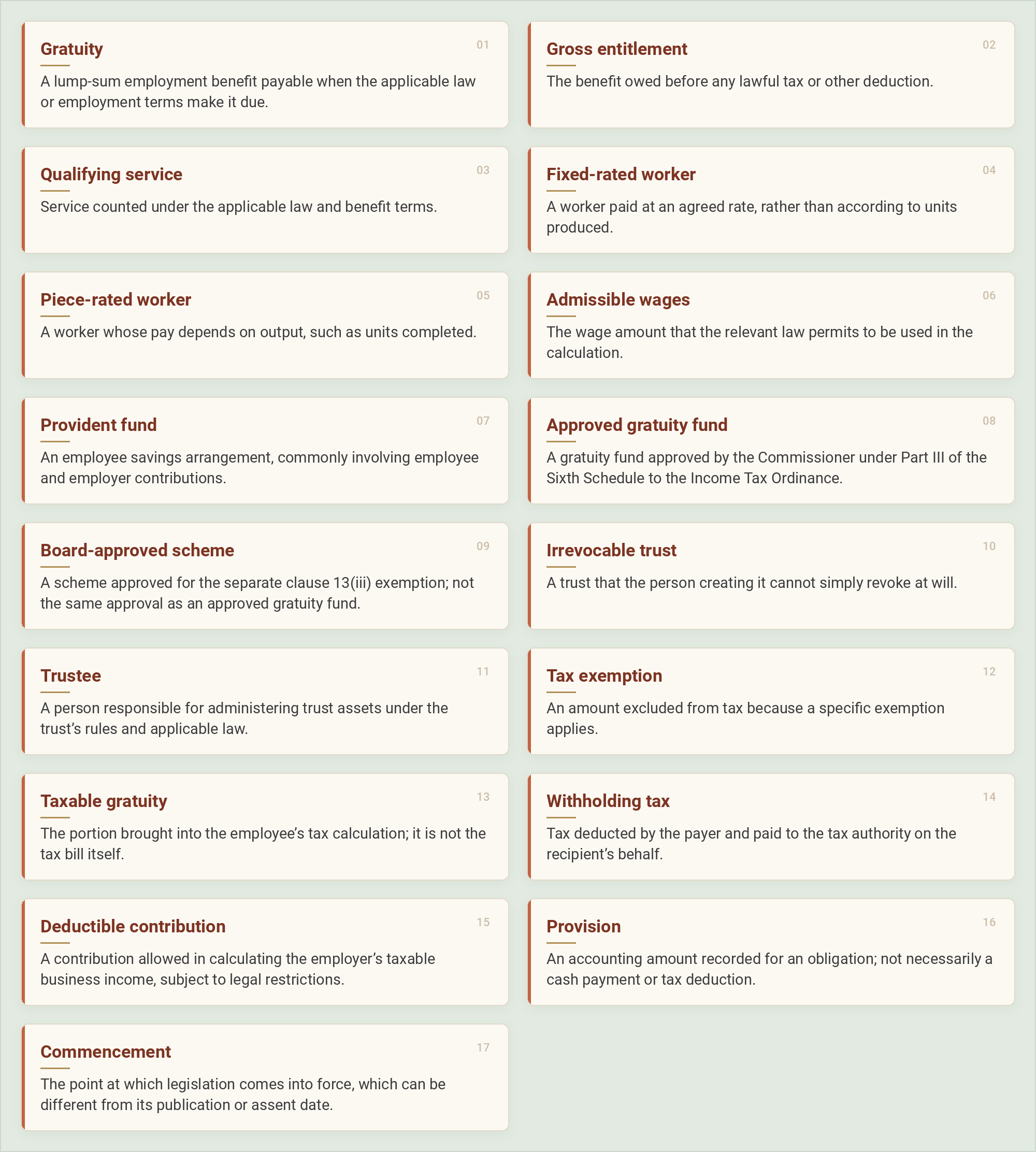
Glossary
Conclusion
Gratuity is not just a final-settlement formula. It connects employment rights, payroll records, fund governance and tax reporting. The strongest starting point is an accurate gross entitlement supported by the right law. From there, the employee exemption, withholding and employer deduction can each be addressed on their own terms.
Expert Arm’s payroll outsourcing services can support service records, calculation workflows and final-settlement controls. Our accounts outsourcing services can help reconcile provisions, contributions and payments, while internal audit can review approvals, supporting evidence and consistency across locations. Jurisdiction-specific legal interpretations, tax positions and fund approvals should be confirmed with the appropriate Pakistani legal or tax adviser and the relevant authority.
This Insight provides general information, not an individual legal or tax determination. Confirm the applicable law, notifications, approval terms and tax-year rules before acting on a particular payment.
Author
Prepared by Hassan Ahmed, CPA
Sources
Provincial Assembly of Sindh
- Sindh employment and gratuity law — Standing Orders Act, 2015: official PDF. The legal title is the Sindh Terms of Employment (Standing Orders) Act, 2015, enacted as Sindh Act XI of 2016. Key pages: 1–4 for coverage and definitions; 12–13 for termination and gratuity. Read with the amendment below.
- Sindh seasonal-worker and standing-orders amendments, 2021: official PDF. Sindh Act XXVIII of 2021. Section 3(v)–(vi), PDF p. 2, changes the seasonal-worker provisions. The two-page PDF is unnumbered.
- Official Act record and official amendment record.
Government of Khyber Pakhtunkhwa — KP Code
- KP employment and gratuity law — Standing Orders Act, 2013: official PDF. Key PDF pages: 2–3 for coverage; 6 for definitions; 15–17 for termination, gratuity and provident-fund provisions. The supplied PDF has no printed page numbers.
- Official Act record.
Government of Punjab — Punjab Laws and Labour Department
- Punjab standing-orders and gratuity provisions — 1968 Ordinance: official PDF. Punjab-adapted text. Key printed pages: 227–228 for coverage and 237 for gratuity; corresponding PDF pages: 3–4 and 13. Use only after confirming its application to the relevant period.
- Punjab Labour Code 2026 — official text PDF. Key pages: 14 for commencement; 81–82 for gratuity, caps and provident funds; 170–171 for repeal and savings. Printed and PDF page numbers coincide in this edition. Inclusion is not a claim that commencement was verified.
- Labour Department laws and policies. The Gazette scan available there has different page numbering from the text edition cited in this Insight.
Federal Board of Revenue
- Income Tax Ordinance, 2001 — updated to 30 June 2026: official PDF. Key printed pages: 49–51 for salary and the termination-payment election; 64–67 for business deductions and restrictions; 314–315 for salary withholding; 573–574 for employee gratuity exemptions; 582 for approved-fund income; 741 and 746–748 for fund definitions and approval. In this PDF, add 19 to the printed page number to find the viewer page.
- Income Tax Rules, 2002 — compilation updated to 24 November 2023: official PDF. Key printed pages: 282–284 for rules 115–120; corresponding PDF pages: 294–296. This is the latest consolidated Rules PDF listed on the FBR index at review, not a representation that no later individual SRO exists. The current Ordinance’s deduction restrictions must also be applied.
- Official Ordinance index and official Rules index.
References
Supporting PDF sources
- Khyber-Pakhtunkhwa-Employment-and-Gratuity-Law-2013.pdfPDF document
- Pakistan-Income-Tax-Ordinance-2001-Updated-30-June-2026.pdfPDF document
- Punjab-Labour-Code-2026-Gratuity-and-Employment-Provisions.pdfPDF document
- Punjab-Standing-Orders-and-Gratuity-Law-1968.pdfPDF document
- Sindh-Employment-and-Gratuity-Law-Standing-Orders-Act-2015.pdfPDF document
- Sindh-Seasonal-Worker-and-Standing-Orders-Amendments-2021.pdfPDF document
- Expert-Arm-Pakistan-Gratuity-Explained.pdfPDF document